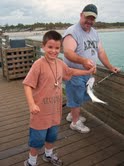
As a picture is a thousand words, enjoy the smiles through my lens: 


 AND MORE!


 "FISH ON!" Venice Pier Anglers
.


 SHARKY’S ON THE PIER PRESENTED:The Biannual Family Fishing Tournament
 Sponsored by
Sharky's on the Pier Casual Dining & Papa's Bait Shop on the Pier in sunny Venice Florida. Home to the Sharks Tooth Coast as it is
"The Sharks Tooth Capital of the World!"
By Gary A. Anderson
Papa’s Bait Shop on the Venice Fishing Pier hosted the “Family Fishing Tournament” on Saturday, April 10 2010 from 8 AM to 11 AM. Entry fees to fish were a donation of a non-perishable food item for the Trinity Presbyterian Food Bank. Donations or not, all children who had a wish to fish and have fun out on the boards of the pier at Sharky’s, also attended the event. Prizes awarded to all youth between the ages of five through seventeen. The prizes of first, second and third place awarded to each of the 3 age groups, 5 to 9, 10 to 12 and 13 through 17 and each child must be accompanied by an adult.
Continental breakfast supplied by Sharky’s on the Pier and registration at seven through the volunteers from the Trinity Presbyterian Food Bank, Carol Ann Mancuso, Barbara Jahnke and Damaris Weidner began the festivities. Prior to the rising of the sun, under a sliver of a moon, volunteers began the preparations in co-hosting this ongoing bi-annual event.
A participant named Joe caught the first two Hardheads (catfish) of the morning with both being a first. A young man of five, James Morrissey with a grand Whiting followed this (Southern-Kingfish) along with a most unusual catch of the day. James said, “I want to catch a Bonnethead. I want one to be caught on my hook.” With this said a bait shrimp placed on his hook and cast from the pier, developed into a whopper of a tale. A few minutes passed and James exclaimed, “I got a bite! Maybe it is my Bonnethead” and with this he reeled in a monster, never seen before and caught on a hook at the on the boards of the pier. There before all was a Bonnethead shark without a body. He caught a head of a small shark, which had circum to a grizzly ending to which someone, or something had decapitated this young shark. A shark without a body but never the less, he caught a Bonnet Head.
The morning continued in warming as the bite picked up with more catfish, pinfish, stingrays and whiting. An onslaught of twenty participants each grinning with enthusiasm as each bite to catch occurred. The stiff east wind and brownish to green sand filtered waters stopped none of these kids in having a great time angling with their selected partner or parent. Volunteers were moving across the boards like ants at a picnic while recording all the fish caught and snapping photographs. All were encouraged to practice CPR, (Catch, Photograph and Release), to learn to respect the marine environments to which was fished.
The following identifications of the species caught today at Papa’s Bait Shop are located in the FWC commission’s publication FISHING LINES.
HARDHEAD CATFISH - Arius felis
Family Ariidae, SEA CATFISHES
Description: brownish to gray-green; white to
yellowish below; fin spines with no fleshy
filaments; barbel at corner of mouth not very
flattened and shorter than head; four barbels
on chin.
Size: to 60 cm (2 ft.) and 5.5 kg (12 lbs.) but usually
much smaller.
Where found: same as for gafftopsail catfish usually much more common.
Remarks: commonly caught from catwalks, bridges, and piers, particularly in passes and inland waterways; edible, but
generally not eaten.
Found on page 32 of http://myfwc.com/docs/Fishing/fish_id2.pdf
PINFISH - Lagodon rhomboides
Family Sparidae, PORGIES
Description: small mouth with incisor-like
teeth; distinctive black spot behind the gill
cover; body bluish-silver with blue and orangeyellow
horizontal stripes, yellow fins.
Where found: seagrass beds, bridges, piers,
marker pilings, and around natural and artificial
reefs; spawn offshore.
Size: usually less than 8 in.
Remarks: popular live bait, notorious bait stealers
found on page 26 http://myfwc.com/docs/Fishing/fish_id2.pdf SOUTHERN STINGRAY - Dasyatis americana
Family Dasyatidae, STINGRAYS
Identification: disk almost a perfect rhombus, with
pointed corners; ventral finfold on tail long and relatively
high, dorsal finfold rows near shoulder; disk usually
uniform dark brown above, grayer in young.
Size: to 1.8 m (6 ft.) across disk.
Where found: common in bays and estuaries.
Remarks: the largest stingray along our southeastern
and Gulf shores.
Found on page 4 of http://myfwc.com/docs/Fishing/fish_id2.pdfSOUTHERN KINGFISH - Menticirrhus americanus
Family Sciaenidae, DRUMS
Description: grayish brown above, with
silvery sides: 7 to 8 diagonal dusky bars or
blotches on each side, but these marks are
obscure and never form V-shaped marks on
side; scales on chest about same size as those
on body.
Size: to 38 cm (15 in.) and 1 kg (2 lbs.).
Where found: shallow coastal waters; common
along beaches.
Found on page 31 To Purchase a Florida Fishing LicenseOur Pro Youth Anglers


 Posts
Posts

